I saw a video recently about a game I’d never heard of called Technotopia. It looked interesting, despite some flaws.
So I went to look it up on Steam and saw that it (1) had been updated a few times since the video came out, so maybe had fewer flaws, and (2) was a whole $3.34 at the time, on sale from a regular price of $5, so why the hell not try it? It’d been a while since I’d spent time with a simple puzzle game that didn’t suck…
Then I played it for about seven hours that day, which I suppose counts as an endorsement.

Technotopia’s story is secondary to its game mechanics, especially once you get past the campaign, but it’s also the best place to start explaining those mechanics, so here’s part of the opening text:
Social and economic conflicts have rocked the world. To maintain stability, people built a high-tech metropolis. It was called Technotopia.
Four people led the population. Although the heads divided the spheres of influence, the factions began a secret rivalry for control of the city.
Due to the conflicts, Technotopia began to fall apart. The faction leaders began to look for a way to maintain the precarious stability and balance.
The situation was saved by a brilliant inventor, the Architect. He proposed creating an Artificial Intelligence…
You play that AI, and your job is to balance those leaders’ appetites. There are meters for the different factions’ “resources,” which are depleted by an increasing amount each week; if any of them is zero at the end of a week, it’s game over.
The main way you get resources is to place buildings on the map. There are four types of basic buildings, one for each faction, and you can place ten per week. Grouping buildings into districts of four gives you more resources, and the shape of the district determines which faction gets that payout; factories benefit the Public faction, for instance, but putting four factories in a line also benefits the Business faction.
There are also special buildings, some of which give you a bonus if you’ve filled every space around them with something else.
There’s half of a deckbuilder mixed into this; you have a hand of three cards that determines which buildings you can place right now. It’s only half of a deckbuilder, though, because you have only limited control over what’s in your deck. You can sometimes choose which card is added, but not often enough to fully count, and there’s no apparent way to remove cards you want less of.
And, being a roguelite, there’s a meta-progression – tied, in an unclear way, to what factions you favor in “event” choices – in which you unlock more cards (and the occasional other bonus). The game thus gets easier to get farther in over time.
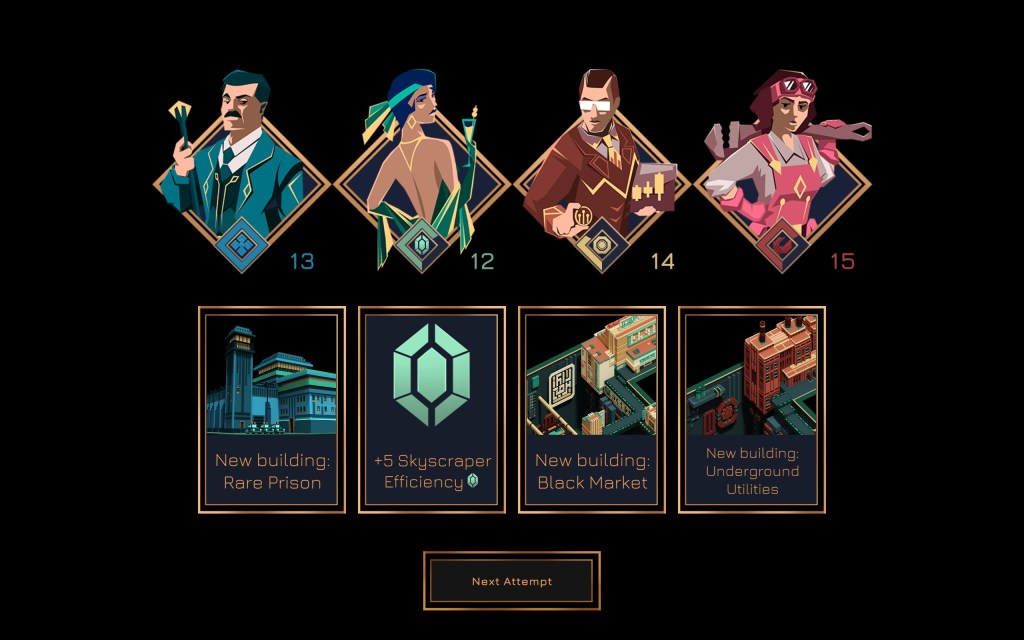
Back to the writing. There’s a campaign; without spoiling too much, you find out that each faction leader is a horrible bastard. The Business leader will hack you at one point and to try to enrich his faction while screwing the others (and, indirectly, you), and he’s arguably the best of them; you’ll also see wasteful vanity projects, election rigging, support for terrorism, and at least two murders.
Each of them has the ability to shut you down remotely, and the campaign is about your quest to sabotage that ability.
The campaign is OK while it lasts, but it’s also a bit shallow, which was probably unavoidable when the possible objectives are limited to “build in this area,” “build X of this type of building,” “build around this special building that just appeared on the map,” and “play this special card that is now in your deck.”
It’s also pretty short, and afterward the writing outside of events is all implied. The “police station” and “prison” special buildings, for instance, only benefits the Government, whose T-shaped districts will populate the city with what appear to be Gotham City-style police blimps. And I’m not sure if this was an obscure reference or a coincidence, but the Business districts form monorails.
The events I mention happen every week and your choices have primary and secondary effects on the factions, but some of those effects are non-obvious enough to make me wonder if the secondary effect is in fact randomized and the writer sometimes struggled to explain the results. Either that or the writer’s political opinions are semi-random…

And the fridge horror of a city-building roguelite – what happened to all the previous Technotopias, and the people in them – isn’t touched on at all. The faction leaders don’t care, the Architect doesn’t care, and you can’t care.
But like I said, the writing is secondary to the gameplay here, and the gameplay is simple but satisfying. Sometimes all you want to do is put some puzzle blocks down and see how many turns you can last, and Technotopia lets you do that.



 Ray of Infamy
Leave a comment