I was recently informed by a random YouTube recommendation about The Secret of Weepstone, which bills itself as a “hand-drawn black and white dungeon crawler RPG inspired by classic D&D of the 80’s.”
That’s what it is, and at least in the demo, that’s all it is. It’s nostalgia bait. But I didn’t mind.
You know how some fantasy games will zoom in to an old book or a hand-drawn map while introducing you to their story? This game starts by zooming in to a mock-up of an old-school D&D module of the B/X era.
(The first picture of the game’s Steam announcement post isn’t splash art for the game itself, or a screenshot; it’s a picture of Keep on the Borderlands.)
Anyway, on to the adventure. It’s a very classic story: the local lord has a mysterious illness and is raving about the local abandoned castle, so his brother recruits some adventurers to go there and see if there’s any connection.
And by “recruits some adventurers,” I mean he calls a town meeting at the local tavern and asks for six level 0 commoner volunteers. The demo has seven available characters, which limits the possibilities of party composition, but the selection screen has a bunch of other characters who will probably be in the full game…

So your party ventures forth, with an alleged weapon apiece (including rusty daggers and a weighted teddy bear) and one piece of armor between them. The portcullis closes behind them, loudly, leaving them nowhere to go but forward, deeper into the castle…
What follows is a simplified and unchallenging version of the D&D dungeon crawling experience. There are a few puzzles, but the most involved one is as follows: you need a key to open a door, and you have access to a working blacksmith’s forge and will find a key mold in one of the neighboring rooms.
There are four combat encounters in the demo, and to put their challenge level in perspective, a rust monster1 counts as a miniboss. The actual boss fight is against an evil cleric, and after summoning skeletons with her cutscene powers, the most she did in my two playthroughs was paralyze one party member for a couple of rounds. And all the skeletons did was delay the party’s ganging up on the cleric for a round or so.
Or to put it another way: there’s one healing potion available in the game, and in those two playthroughs, I didn’t have to use it.
I’m not faulting the demo for its low difficulty, because I assume the full game is at least intended to get more challenging over time, and that the characters will have to gear up and level up to meet that challenge. Also, erring in the opposite direction and making the demo an old-school meatgrinder would have turned a lot of players off, probably including me.
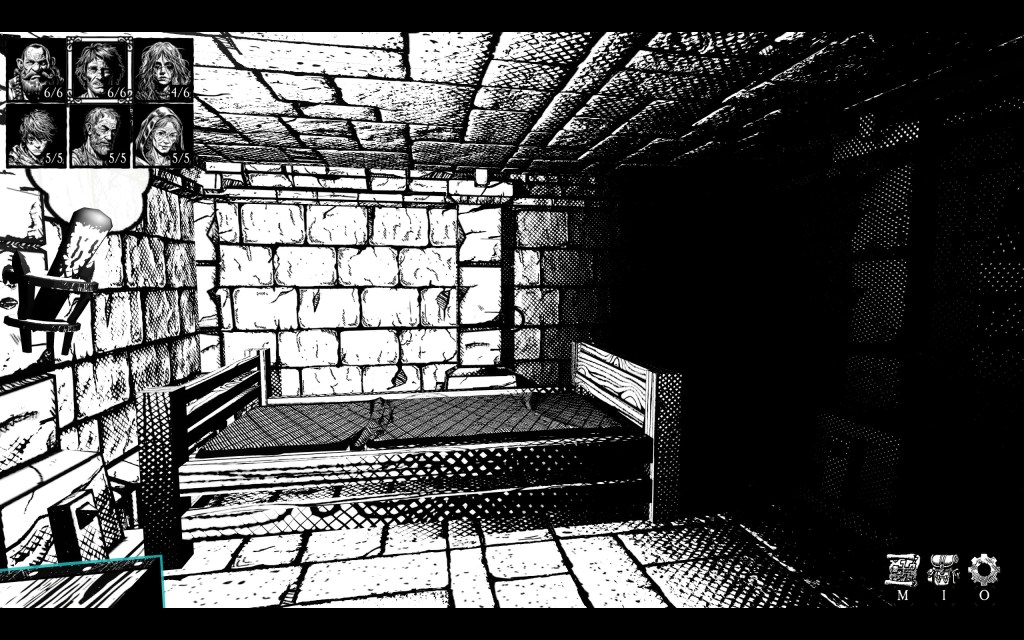
I could fault the demo for the lighting, which is evocative in a few set-piece views but just sucks elsewhere. There are light sources, mostly mysteriously lit torches fixed to the walls, but they only illuminate about a five-foot radius, outside of which you’ll be rubbing your face against the wall trying to find loot2 or, in at least one instance, a door.3
The narration for that key-mold puzzle mentioned that your party is carrying torches. You could have fooled me.
Also, while I appreciated the in-game map being old-school white-on-blue, I appreciated its white-on-white “you are here” marker a lot less.

And while I didn’t quite get bored with the repeated dice-rolling animations during combat, I did note the existence of a “speed up the dice rolling” setting for possible future use. And since (again) I played through twice, there are only four combats, and was already thinking about that setting, I can imagine it being very popular.
I did appreciate the black-and-white style in general, though. That might just be my age; while I’m not quite old enough to have played Keep on the Borderlands back in its day, the earlier issues of Dungeon Magazine had black-and-white interior pics, so this hits me right in the nostalgia. Other than the lighting, it was all reasonably well done.4
Oh, and the game’s narrator and NPCs are fully voiced. That helps a lot.
I’m not going to fully recommend the game until I see how much more content it’ll have and at what price, but (again) I want to see more. Wishlisted.
- It’s called an “Iron Belly” in the game, but it’s a metal-eating land crayfish the size of a Great Dane and we all know what that’s called. And it’s probably the AD&D or 2nd Edition rust monster, because it has two attacks.
- A simple spear or morningstar wouldn’t count as “loot” or even vendor trash in a lot of other games. But given the so-called weapons the party started with, ditching a 1d4-1 rusty dagger for a 1d6 weapon feels like meaningful progression.
- In the unlikely event that this was a deliberate design choice, intended to evoke the old “check every square foot of wall for secret doors” style of gameplay… it was a mistake.
- I’ve seen a few social-media comments about one or both of the game’s artists using AI, but neither of them mentions AI tools or skills in their online profiles, and my admittedly untrained eye detected no slop in the game.


 Ray of Infamy
Leave a comment